
Two modular solutions to add instant impact on scalable foundations
The two solutions can be deployed in combination or separately. Each deployment is different because the existing solutions are incorporated as each customer’s starting position is different.
Configure and deploy protocolised care pathways focused on the meeting of care settings such as Single Point of Access, chronic monitoring, virtual wards, therapeutic distribution and research where multiple organisations, teams and technologies touch the patient journey.
Configure and deploy data workflows that connect pathway data across systems, create structured datasets on open standards, connect data silos and support analytics as a new generation interoperability engine.
Solution value
Fast to build
Rapid pathway, API and mapping capabilities using GenAI and drag-and-drop.
Fills system gaps
Works and integrates with existing systems, services and teams. Does not require heavy technical resourcing.
Higher quality, interoperable data
Creates structured, harmonised, analytics-ready data with a visible trail, serving the right data to the right person, enabling safer AI deployment and better decisions at scale.
When deployed together
Discover
Together with the clinical and operational teams who will run the service, we design the pathway around real clinical priorities, patient volumes and the staff you have.
Configure
Triage rules, worklists, forms, messaging and role-based access are configured from components already proven in complex care services.
Integrate
We connect to the systems you already use, pulling data, launched directly through them and writing back. Nothing is replaced or migrated, and new systems connect to the same foundation instead of adding another silo.
Test & Train
End-to-end and user acceptance testing, staff training and updated operating procedures, so teams are ready before go live.
Go live
Clinical safety and information governance sign-off. You go live with a defined cohort and hands-on support, then scale once it’s proven.
Care workflow examples
Single point of access
Big Picture Medical provides a digital infrastructure solution for Single Point of Access. It streamlines referrals, triage and patient flow. It reduces admin workload, speeds up access to care and gives teams real-time visibility across the care journey.
- Digital front door. A single entry point that consolidates all referrals into one unified worklist.
- Triage and routing. Algorithm-driven prioritisation that routes patients to the right next step.
- Patient comms and data capture. Onboarding letters, questionnaires, reminders, updates, and waiting well support.
- Shared clinician view. Real-time visibility of demand, status, and next actions across teams.
- EHR integration. Works with EHRs such as EMIS and SystmOne.
Single point of access for weight management
Big Picture Medical provides a digital infrastructure solution that creates a Single Point of Access for weight management services, consolidating referrals into one unified worklist, capturing data in the community, automating triage with clinical algorithms, and routing patients to the right intervention.
The solution is live in the NHS at an ICB level and meets OPIP funding criteria for digital infrastructure innovation.
Weight management services struggle with fragmented, manual processes: hundreds of referrals arrive monthly from GPs, community teams, each requiring manual review and routing to digital programmes, specialist clinics, GLP-1 medications, or bariatric surgery. With obesity affecting 26.5% of adults in England and costing the NHS £6 billion annually, services cannot afford delays or misrouted patients. Without a unified system, teams chase information across emails and spreadsheets, leading to slow triage, inconsistent decisions, and limited visibility into demand.
What it does
- Referrals and onboarding. Consolidates all referrals into one digital front door with a unified worklist. Integrates with GP EHRs. Captures baseline information digitally in the community so referrals arrive complete, structured, and triage-ready.
- Triaging. Algorithm-guided triage with clinical oversight routes patients to the right service first time, with automated hand-offs reducing manual admin.
- Operations. Single live worklist with status, priority, and next actions gives teams real-time visibility of demand and flow to manage backlogs.
- Patient comms. Patient communication with reminders, onboarding questionnaire for data capture, and waiting well resources while patients are in the queue.
Impact
Significantly reduced administrative workload, faster access to care, shrinking waiting lists, and measurable cost savings through decreased admin time and avoidable interventions, with real-time data evidencing improvements in outcomes and performance.
Single point of access for ADHD and autism
The UK’s mental health system is under extraordinary strain: 1.8 million people waiting for treatment, £118 billion in annual economic cost. Most of it traces back to fragmented health and social care that makes coordinated delivery almost impossible. For someone living with mental illness there is no system, just a maze of disconnected services. Our infrastructure unifies them, speeding entry into care and giving teams visibility across the whole journey.
ADHD and autism services are under intense pressure, some patients waiting up to eight years for assessment. With no single pathway owner and little end-to-end visibility, providers cannot see where patients are stuck, where backlogs build, or track outcomes consistently.
Our infrastructure provides one front door. Referrals arrive structured and risk-prioritised, and real-time visibility into demand, capacity and bottlenecks helps services cut wait times, route patients to the right intervention faster, and reduce reliance on costly Right to Choose providers.
Aligned with NHS England’s ADHD Taskforce recommendations and the NHS 10 Year Health Plan.
What it does
- Digital front door for referrals management. All referrals, from GPs, schools, community teams or self-referral, arrive in one structured format with complete clinical and developmental information.
- Intelligent prioritisation. Clinical algorithms surface urgent cases and route patients to the right provider first time, cutting manual triage.
- Connected assessments. Each assessment builds on the last, so patients do not repeat themselves and providers see the full picture.
- Support while waiting. Automated updates and engagement keep patients and families informed through long waits.
Impact
Faster access to care, shorter waiting lists, better triage between Right to Choose and NHS capacity, and reduced admin.
Chronic home monitoring
Big Picture Medical provides a digital infrastructure solution for chronic monitoring that helps teams proactively identify, prioritise, and manage patients with long-term conditions. It brings together patient-reported data, clinical information, risk signals, and team workflows into one shared view, reducing admin workload, improving visibility across cohorts, and supporting faster, safer intervention.
- Proactive identification. Identifies patients who need monitoring, review, optimisation, or escalation before issues become urgent.
- Cohort management. Unified worklist segmented by condition, risk, pathway stage, priority, and next action.
- Triage and escalation. Algorithm-supported prioritisation to identify patients needing review, optimisation, or urgent follow-up.
- Patient comms and data capture. Digital questionnaires, reminders, education, and waiting well support between appointments.
- Shared clinician view. Real-time visibility of patient status, risks, overdue actions, and team workload across services.
- EHR integration. Integration with EHRs such as EMIS and SystmOne to support joined-up clinical workflows.
Cardiovascular-renal-metabolic (CVRM) management
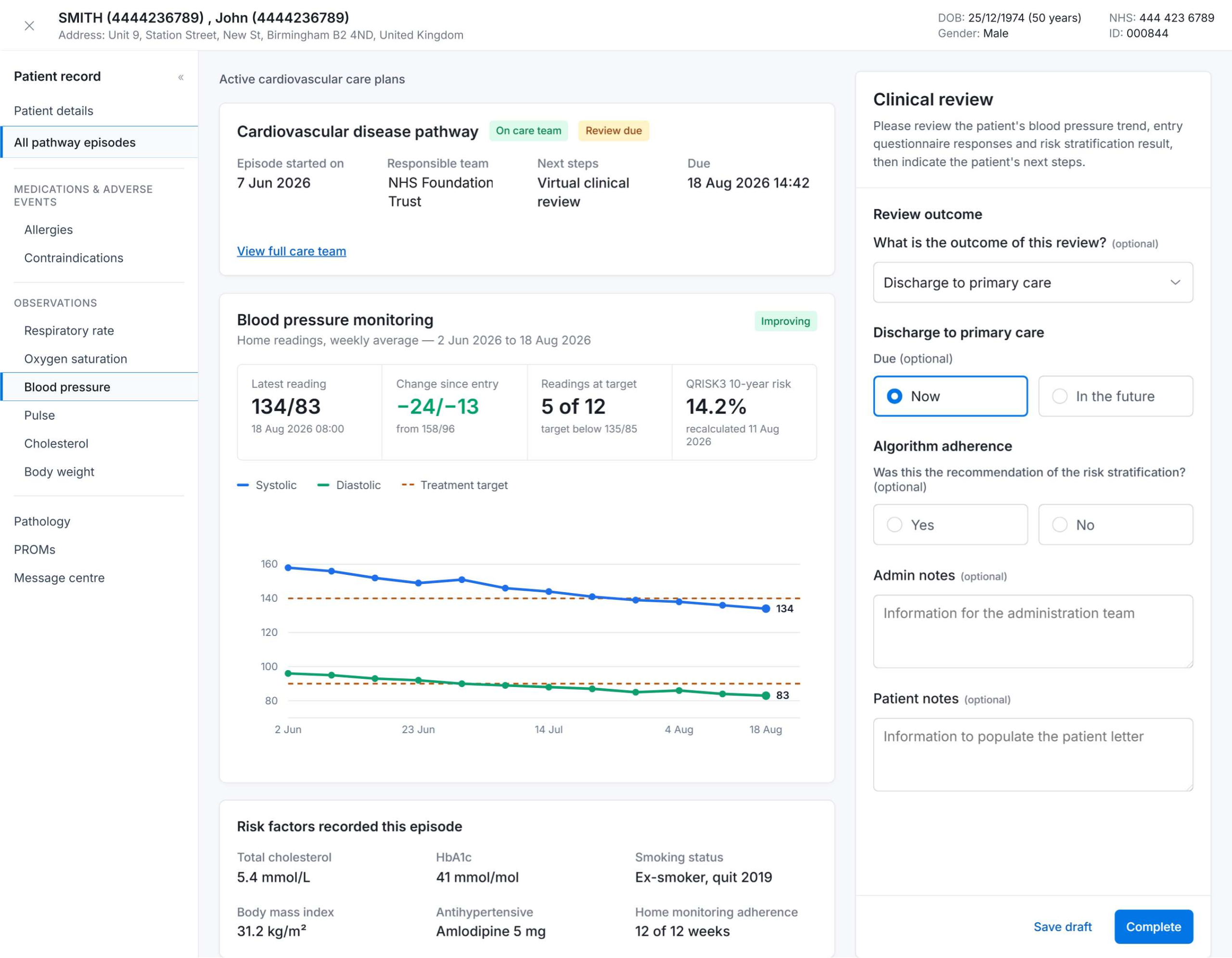
Big Picture Medical provides a digital infrastructure solution for cardiovascular-renal-metabolic monitoring, creating a single shared view of patients across cardiovascular disease, chronic kidney disease, diabetes, obesity, hypertension, and related risk factors. It supports proactive identification, prioritisation, optimisation, and follow-up across primary care, community teams, and specialist services. Without a unified system, teams chase information across registers, emails, spreadsheets, and clinical systems, meaning patients do not receive holistic management and teams have limited visibility into risk, demand, and outcomes.
CVRM conditions management is often reactive and fragmented across multiple pathways, teams, disease registers, spreadsheets, call-and-recall processes, and clinical systems. Patients may have overlapping risks and conditions, but teams often lack a single view of who needs action, what has already happened, and where the biggest opportunities are for prevention, optimisation, and early intervention. Without a unified system, CVRM teams are forced to piece together information from emails, spreadsheets, disease registers, and clinical systems, meaning patients are not managed holistically across their overlapping risks and conditions, leading to delayed identification, inconsistent prioritisation, fragmented follow-up, missed optimisation opportunities, and limited visibility into outcomes.
What it does
- Referrals and onboarding. Consolidates referrals, patient cohorts, and review activity into one digital front door with a unified worklist. Captures baseline information digitally and supports integration with GP EHRs so teams can act from a shared, up-to-date view.
- Risk stratification. Algorithm-supported prioritisation helps identify patients at highest CVRM risk, including those with poorly controlled blood pressure, diabetes, CKD, obesity, lipid risk, or multiple overlapping risk factors, with partner support for specialist risk tools and diagnostic tests where appropriate.
- Medicine optimisation. Supports structured medication review, guideline-led optimisation, follow-up planning, and escalation to the right clinician, service, or specialist partner where appropriate.
- Operations. Single live worklist with status, priority, owner, due dates, and next actions gives teams real-time visibility of demand, progress, backlogs, and outcomes.
- Patient comms. Patient communication with reminders, questionnaires, education, monitoring prompts which can be done with partner patient apps that helps patients stay engaged between reviews and supports earlier intervention.
Impact
Move from reactive, fragmented disease management to proactive, population-level intervention, reducing administrative burden, improving QOF performance, identifying high-risk patients earlier, supporting faster optimisation, reducing duplication across teams, lowering avoidable CVD events, and improving long-term patient outcomes.
Data workflow example
Big Picture Medical provides a digital infrastructure solution for healthcare data workflow, connecting data from clinical systems, referral pathways, patient interactions, and service operations into one structured, usable workflow. It reduces manual reporting, improves visibility across services, and gives teams real-time insight into demand, activity, outcomes, and performance.
- Unified data layer. Brings pathway, referral, patient, clinical, operational, and outcomes data into one consistent structure.
- Open standards by design. Supports interoperability using healthcare data standards such as FHIR, NHS login, NHS Spine, eRS, GP Connect, SNOMED CT, dm+d, and open APIs where appropriate.
- Data capture. Collects data at key points in the workflow, reducing manual spreadsheets and retrospective reporting.
- Live dashboards and reporting. Gives teams real-time visibility of demand, status, throughput, waiting lists, activity, and outcomes.
- Insight for service improvement. Highlights bottlenecks, variation, unmet need, and opportunities to redesign care pathways.
- EHR and other systems integration. Integrates with existing systems such as EMIS, SystmOne, AI partner tools and much more.
Connecting data sets into a Clinical Data Repository
A healthcare service may need to bring together multiple data sets from across a pathway: referrals, patient demographics, triage decisions, appointments, clinical activity, patient communications, outcomes measures, and commissioner reporting requirements.
These data sets often sit in different places: EHRs, referral platforms, patient apps, spreadsheets, local trackers, BI tools, and partner systems. Each may use different formats, field names, coding structures, and reporting logic.
Big Picture Medical creates the data workflow that connects these sources into a Clinical Data Repository (CDR), turning disconnected data sets into a single, structured, usable view.
What it does
- Multiple systems are connected. Our technology integrates data sources across the pathway, including referrals, clinical systems, patient apps, digital forms, partner tools, operational trackers, and reporting systems.
- Open standard mapping is applied. Different field names, formats, codes, and pathway definitions are mapped to open healthcare standards and APIs, so the CDR can use the data consistently and securely.
- The CDR becomes the trusted record. Structured, harmonised data flows into the CDR, creating a reliable view of service activity, pathway progress, outcomes, and patient context.
- Teams act from one shared view. Providers, commissioners, dashboards, partner tools, and AI agents can use the same trusted data in real time.
Our technology surfaces the right data, at the right time, to the right person, in the right interface, with clearer provenance, better visibility, and less manual reconciliation.
Impact
By connecting different data sets into a CDR, Big Picture helps healthcare organisations move from fragmented reporting to live operational intelligence. Referral, clinical, operational, patient, and outcomes data can be brought together in one repository, giving services a clearer view of what is happening, where pressure is building, how patients are progressing, and what impact the pathway is delivering. The result is a more connected data foundation that is trusted for service improvement, commissioner reporting, pathway redesign, and safe AI-enabled care.